
Commercial Pipe Lining: An Owner’s Guide to Trenchless Pipe Rehabilitation
A failing pipe in a house is disruptive. A failing pipe in a business, apartment building, restaurant, hospital, school, or commercial property can quickly escalate into a major operational crisis.
A single pipe repair can directly impact:
Tenants • Customers • Employees • Patients • Parking • Kitchens • Bathrooms • Hotel rooms • Production areas • Finished floors • Walls • Revenue
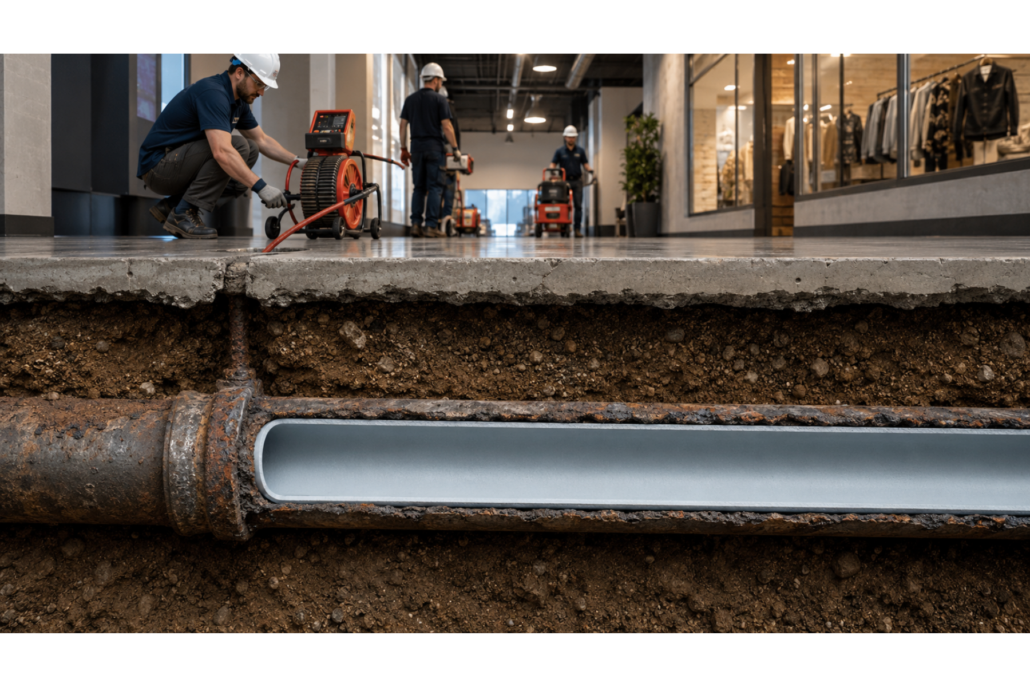
That is why commercial pipe lining is so valuable. Instead of automatically removing floors, opening walls, or excavating parking lots to replace deteriorated piping, trenchless pipe lining allows contractors to rehabilitate existing pipes from the inside out.
Depending on the building and lining system, commercial trenchless rehabilitation can potentially be used on piping located under concrete slabs, beneath parking lots, between buildings, inside walls, in vertical drain stacks, in horizontal waste lines, in roof-drain systems, and in underground sanitary or storm piping.
For commercial property owners, the attraction is straightforward: repair the pipe while minimizing what has to be demolished to reach it. However, commercial pipe lining is not right for every building or every pipe. The first step is identifying exactly what has failed.
What Is Commercial Pipe Lining?
Commercial pipe lining is the rehabilitation of existing piping by installing a new lining system inside the old pipe rather than removing and replacing the host pipe entirely.
One of the most widely used technologies is CIPP pipe lining. With CIPP, a resin-saturated liner is positioned inside the existing pipe, expanded against the pipe wall, and cured to form a new, continuous pipe within the old one.
Plumbing code ASTM F1216 describes CIPP as reconstructing existing pipelines and conduits with a resin-impregnated flexible tube that is installed and cured in place.
Commercial projects range from isolated sections of damaged drainage pipe to full rehabilitations of a building’s drainage infrastructure. The key concept is rehabilitation—the host pipe remains in place while the new lining becomes the fully functional interior pipe.
What Types of Commercial Properties Can Use Pipe Lining?
Commercial pipe rehabilitation is not limited to standard office buildings. It is routinely considered across a wide spectrum of properties:
- Hotels & Resorts
- Apartment Complexes
- Condominiums
- Hospitals & Medical Facilities
- Assisted-Living Properties
- Restaurants
- Schools & Universities
- Retail & Shopping Centers
- Office Buildings
- Warehouses & Industrial Parks
- Manufacturing Facilities
- Government Buildings
- Sports Facilities
- Mixed-Use Developments
The value becomes particularly significant in occupied buildings where traditional replacement requires taking revenue-generating spaces out of service:
- Hotel Operators: Focus on how many rooms must be removed from inventory.
- Restaurant Owners: Need to keep the kitchen operational without health code flags.
- Property Managers: Care about preventing residents from losing drain service.
- Retail Owners: Must maintain uninterrupted customer access.
Commercial pipe repair must be evaluated as an operations problem as well as a plumbing problem.
What Pipes Can Be Lined in a Commercial Building?
Depending on the lining technology, pipe condition, and specific application, trenchless rehabilitation can restore several key components of a building’s infrastructure:
Under-Slab Drain and Sewer Lines
These represent some of the highest-value commercial applications. A failed drain beneath a concrete floor typically requires an extensive, disruptive process:
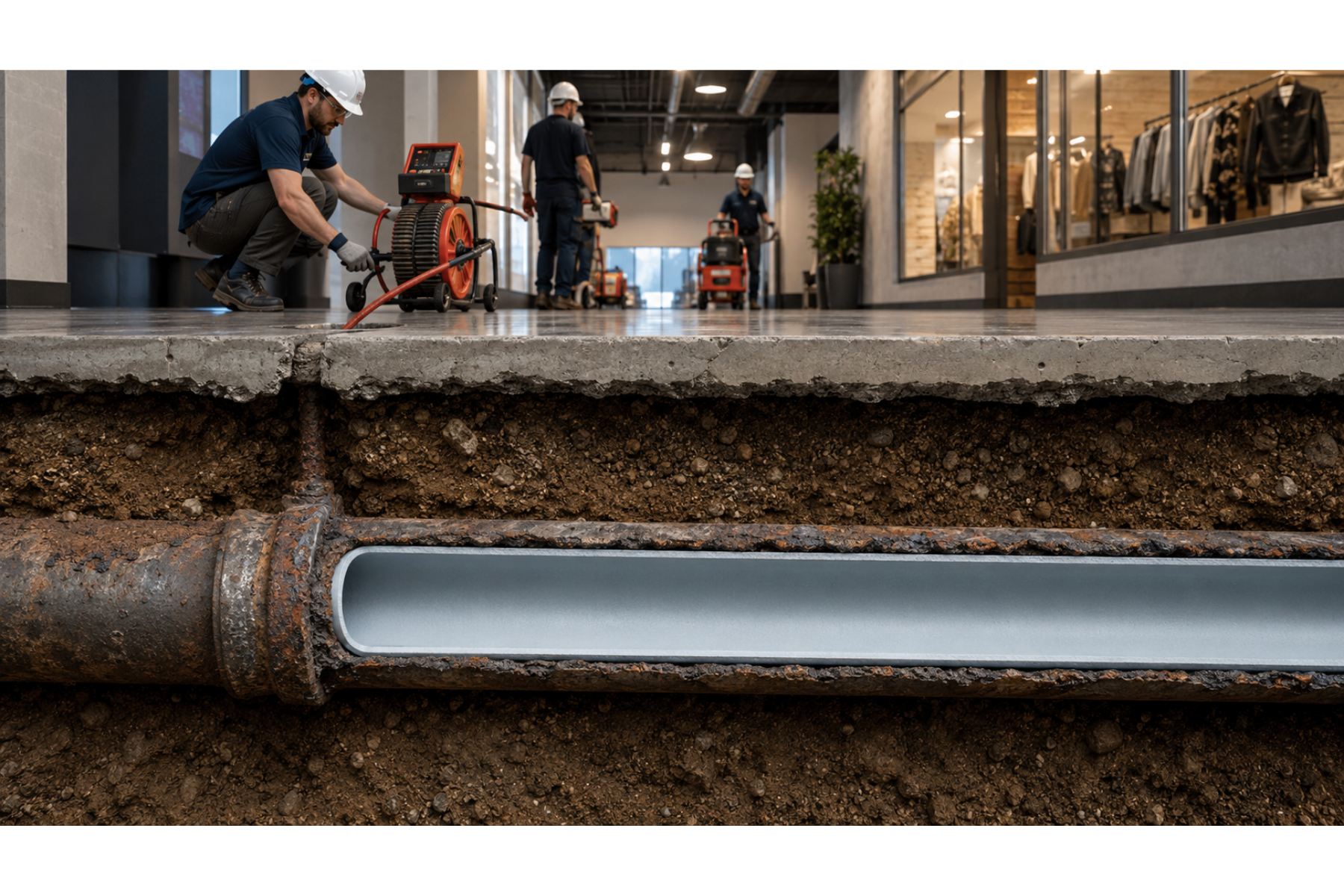
If the existing pipe can be properly cleaned, accessed, and rehabilitated, lining allows property owners to avoid the majority of that structural demolition.
Vertical Plumbing Stacks
Specialized commercial lining systems can rehabilitate vertical waste and drainage stacks. Conventional replacement requires opening walls, ceilings, chases, or multiple floors to access piping across several levels. Modern vertical CIPP systems solve this problem in hotels, apartments, hospitals, and multi-story structures without destructive wall cutouts.
Horizontal Drain Lines Inside Buildings
Horizontal cast-iron and drainage lines running under floors, above ceilings, through utility spaces, or inside parking structures can often be lined. Because commercial building piping is complex with frequent turns and junctions, detailed system mapping and sewer camera inspection are critical before lining horizontal lines.
Roof Drain Systems
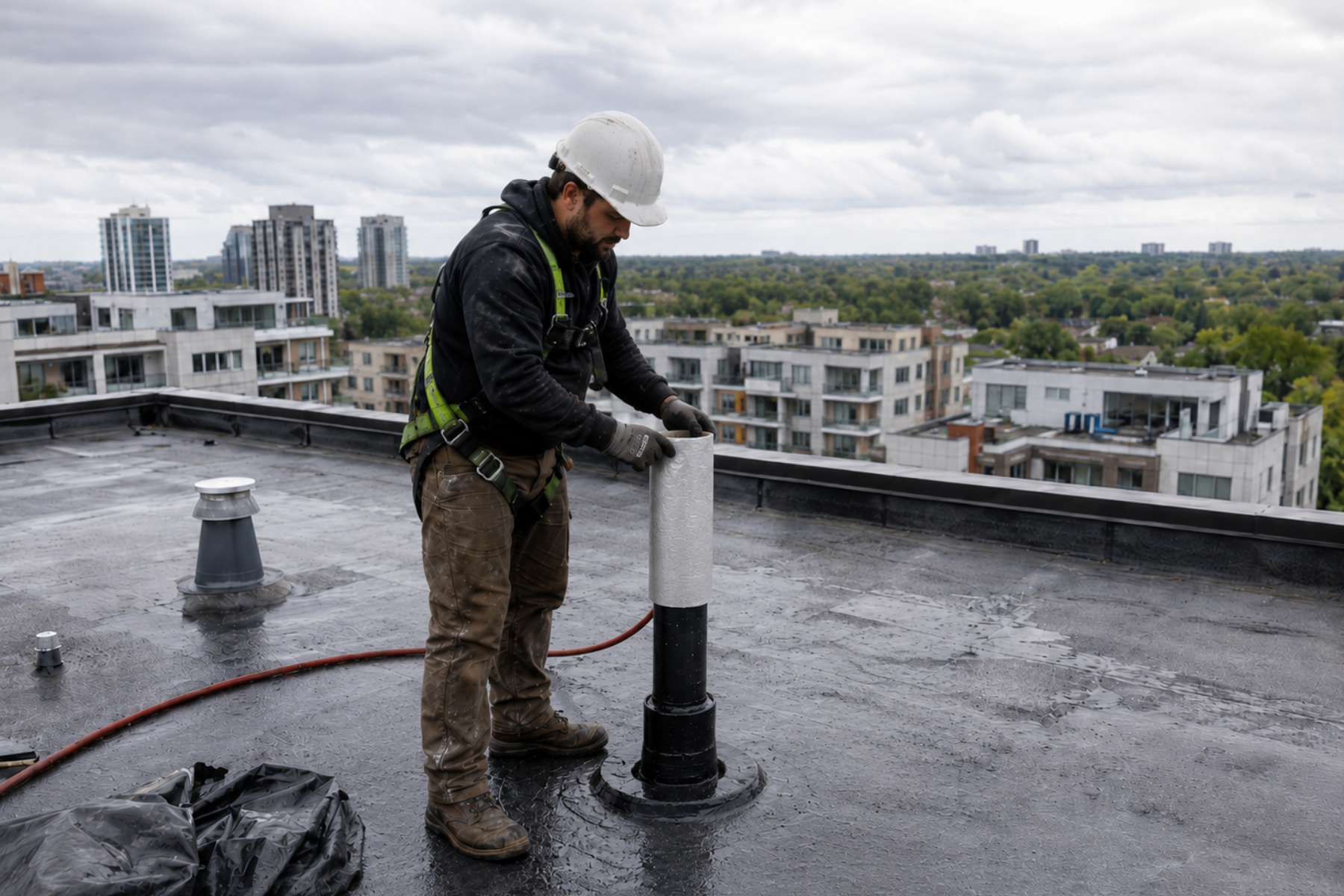
Lining systems effectively rehabilitate roof drains and associated leader piping. Roof drainage is notoriously difficult to replace when lines pass through finished, occupied spaces or inside structural columns.
Underground Sewer Lines Outside the Building
Commercial properties frequently have private sewer laterals running beneath parking lots, drive lanes, sidewalks, or loading docks. CIPP allows for full-length pipeline rehabilitation without closing parking areas or trenching through expensive asphalt and landscaping.
What Pipe Materials Can Be Lined?
CIPP and related technologies are compatible with most common commercial host-pipe materials, including cast iron, clay, concrete, PVC, and storm pipe lining materials.
Focus on Commercial Cast Iron
Cast iron is extremely common in aging commercial properties, but it suffers from heavy internal deterioration over time, such as scale, rust, corrosion, tuberculation, and channeling. Mechanical descaling and surface preparation are required before inserting a liner into cast iron to ensure a smooth, long-lasting fit.
How Does Commercial Sewer camera Work?
A standard commercial CIPP rehabilitation project progresses through eight structured steps:
- Initial System Inspection: HD camera inspection identifies cracks, corrosion, failed joints, root intrusion, deformation, and system bends.
- Drainage System Mapping: Contractors map active branch lines, floor drains, and fixtures to ensure service connections are preserved.
- Pipe Cleaning & Preparation: High-pressure hydro-jetting or mechanical descaling removes roots, scale, grease, and corrosion buildup down to the pipe wall.
- Final Pre-Lining Inspection: A second CCTV pass confirms the pipe’s exact diameter, cleanliness, and readiness for liner insertion.
- Liner Installation: A resin-saturated flexible liner is positioned using inversion or pull-in-place methods (governed by ASTM F1216 or NASSCO standards).
- Curing Process: The liner is expanded against the host pipe and cured using hot water, steam, ambient air, or photoinitiated UV light.
- Branch Connection Reinstatement: Robotic cutters travel inside the newly lined pipe to precisely re-open covered branch lines and fixture connections.
- Post-Installation Quality Inspection: Final camera inspection documents the finished liner quality. Property owners receive copy recordings of both pre- and post-inspection video.
Advanced Technologies & Special Considerations
UV Pipe Lining
UV CIPP utilizes light energy rather than heat to cure light-sensitive resin. Light rigs travel through the installed liner, providing fast cure times, precise curing records, and minimal footprint on job sites.
Is CIPP Structural?
Yes. CIPP systems can be engineered as fully structural standalone pipe solutions. Standards like ASTM F1216, ASTM F2019, and ASCE MOP 145 define liner thickness calculations based on host pipe condition, soil loads, and water table levels.
Important Technical Limitations
- Collapsed Pipes: If a pipe is completely crushed or lacks an open pathway, CIPP cannot be installed without localized excavation or pipe bursting first.
- Bells or Bad Slopes: CIPP liners follow the existing pipe’s path (line and grade). Lining a pipe with a severe sag or belly will not lift the pipe—the structural wall will be repaired, but the slope issue will remain.
- Potable Water Warning: Drinking water and pressurized lines require specific NSF/ANSI certifications, pressure ratings, and installation standards separate from gravity-drain CIPP.
Commercial Pipe Lining vs. Traditional Replacement
| Feature / Consideration | Commercial Pipe Lining | Traditional Replacement |
|---|---|---|
| Existing Host Pipe | Remains in place (rehabilitated) | Removed or completely abandoned |
| Floor & Wall Demolition | Significantly reduced or avoided | Often extensive and highly disruptive |
| Pavement & Parking Excavation | Minimal (access points only) | Frequently extensive open trenching |
| Business Operational Downtime | Low to minimal (hours vs. days) | Substantial (days to weeks) |
| Can Correct Severe Line Grade? | No (follows existing slope) | Yes (re-excavated to proper grade) |
| Structural Rehabilitation | Yes (engineered liner) | Yes (brand-new pipe installation) |
Understanding Costs and Operational Impact
Comparing pipe lining to traditional pipe replacement strictly on a “per-foot” basis can be misleading. On paper, trenchless installation costs may seem comparable to plumbing labor, but the true value lies in the total project footprint:
Traditional Replacement Total Cost:
Plumbing Labor + Concrete Demolition + Excavation + Concrete Pouring + Floor Restoration + Wall Repair + Equipment Downtime + Lost Business Revenue.
Pipe Lining Total Cost:
Trenchless Rehabilitation + Minimal Access Prep + Minor Restoration.
When evaluated holistically, avoiding operational downtime and major restoration makes trenchless pipe lining one of the most cost-effective capital investments available to commercial facilities.
Frequently Asked Questions
What is commercial pipe lining?
Commercial pipe lining rehabilitates existing drainage or utility piping by inserting and curing a new interior pipe system inside the old host pipe without needing total excavation or demolition.
Can vertical plumbing stacks be lined?
Yes, specialized vertical CIPP lining systems are specifically designed to rehabilitate multi-story drainage and waste stacks without tearing out walls or chases.
Can pipes under concrete be repaired without digging?
Yes. Under-slab trenchless lining allows contractors to clean, prep, and line broken or corroded pipes beneath slab foundations from cleanouts or small access entry points without breaking up interior concrete floors.
Can cast-iron pipes in an apartment building be lined?
Yes. Aging cast-iron drain systems in apartment complexes and condominiums can be descaled and lined, restoring smooth hydraulic performance while preventing resident displacement.
Does commercial pipe lining require a complete building shutdown?
Not necessarily. Work can often be scheduled by stack, wing, floor, or zone, or executed during overnight off-hours to prevent disrupting ongoing facility operations.
How long does a CIPP pipe lining last?
Engineered CIPP systems are designed according to long-term ASTM material performance standards to offer a design lifespan of 50 years or more when properly installed.
Does lining reduce the internal diameter of the pipe?
While the liner reduces internal diameter slightly (typically a few millimeters), the smooth, jointless interior finish improves hydraulic flow efficiency, often offsetting the minor reduction in pipe width.
Can localized damage be fixed without lining the entire system?
Yes. Trenchless point repair or sectional CIPP can fix isolated cracks, holes, or joint failures without the expense of lining the entire pipe run.
Contractor Checklist: Questions to Ask Before Hiring
Before approving a commercial pipe lining project, ensure your contractor provides detailed answers to the following:
- How many occupied commercial properties of our type have you successfully lined?
- Can you provide complete pre-lining CCTV inspection footage and line mapping?
- What specific CIPP liner system and curing method are you using?
- How was the required structural liner thickness calculated for our pipe depth and condition?
- What is the precise water/drain shutdown plan and execution timeline for our tenants?
- Will we receive comprehensive post-installation CCTV video and written system warranties?
Is Trenchless Pipe Repair Right for You?
Inspect First. Minimize Disruption. Repair Right.
A failing pipe in a commercial facility does not automatically mean tearing down walls or digging up parking lots. The right solution begins with professional CCTV inspection and diagnostic evaluation.
Find a verified commercial pipe lining contractor near you on Pipelining.com to evaluate CIPP, stack lining, point repairs, and pipe bursting options engineered for your facility.