
Trenchless Point Repair: Fixing a Damaged Section of Pipe Without
Repairing the Entire Line A cracked sewer pipe doesn’t necessarily mean the entire sewer line needs to be replaced or lined. If most of an underground sewer or drain is still in usable condition but one isolated section has failed, a trenchless point repair may be able to repair only the damaged area from inside the existing pipe. One of the most common methods is a sectional cured-in-place pipe repair, sometimes called:
- A CIPP point repair
- Sectional liner
- Short liner
- Pipe patch
- Sewer lining patch
- Sectional CIPP
- Localized CIPP repair
These terms can describe slightly different products or installation techniques, but the basic idea is similar: Instead of lining 50 feet of decent pipe to repair a 6-foot defect, the contractor installs a structural lining repair at the location that actually needs it. NASSCO recognizes CIPP as a trenchless technology that can be used both for full-length rehabilitation and for localized sectional repair.
For the right pipe defect, that can mean: Less excavation. Less material. Less disruption. And a repair focused exactly where the pipe has failed. But point repair is not right for every sewer problem. The key is determining whether the problem is truly localized or whether it is evidence that the entire pipeline is deteriorating.
What Is a Trenchless Point Repair?
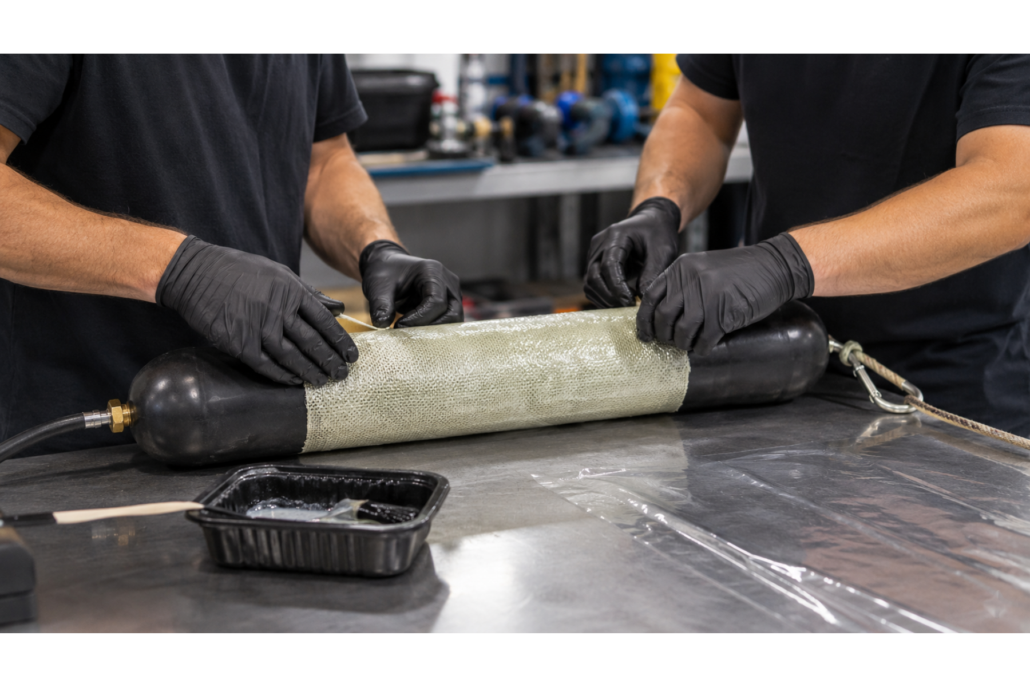
A trenchless point repair fixes a localized section of an underground pipe from inside the existing pipeline without excavating the entire damaged area. In a typical sectional CIPP point repair, a resin-saturated reinforcing material is positioned directly over the damaged section. The material is expanded tightly against the inside of the existing pipe and held in position while the resin cures. Once cured, the repair creates a new structural section inside the damaged host pipe. ASTM F3541 specifically covers sectional repair of gravity-flow, non-pressure pipelines using a resin-saturated liner placed on or around a carrier device, pushed or pulled to the repair location, expanded against the host pipe and cured in place. ASTM also maintains a separate standard practice, F2599, addressing sectional repair using an inverted cured-in-place liner. For a property owner, the important concept is simple: The contractor repairs the bad section instead of automatically rehabilitating or replacing the entire pipe.
Is a Sewer Point Repair the Same as Full
Pipe Lining?
No. They use similar CIPP principles, but the amount of pipe being rehabilitated is different.
Full-Length CIPP Lining
A liner is installed through a substantial length of the existing pipe. That may be appropriate when defects, corrosion, cracks or deterioration exist throughout much of the pipeline.
Sectional Point Repair
A much shorter liner or patch is installed over a specific defect or group of closely located defects. That may be appropriate when the rest of the pipeline is still in satisfactory condition. CIPP is capable of repairing localized damage through trenchless sectional repair as well as rehabilitating much longer pipeline segments. The right question to ask your contractor is: “Is the damage truly limited enough that repairing only this section makes sense?”
How Does a Trenchless Pipe Patch Work? work?”
Although specific systems differ, a sectional CIPP point repair generally follows this process.
1. The Pipe Is Inspected With a Sewer Camera
The contractor first locates the defect and determines:
- Pipe material
- Pipe diameter
- Exact defect location
- Defect length
- Condition of the surrounding pipe
- Presence of roots
- Corrosion or scale
- Offset joints
- Changes in diameter
- Bends
- Connections
- Access
This step is critical. A point repair should not be recommended simply because a contractor sees one obvious crack. The rest of the pipe must also be evaluated. If twenty additional defects are developing, patching one section may not be the smartest investment.
2. The Pipe Is Cleaned and Prepared
The repair area needs to be properly prepared before lining. Depending on the pipe, this can involve:
- Sewer cleaning
- Root cutting
- Removing grease or debris
- Removing mineral buildup
- Descaling cast iron
- Cutting protrusions
- Preparing the damaged surface
Proper cleaning and preparation are fundamental parts of CIPP installation. EPA quality-control guidance for CIPP identifies host-pipe cleaning as an early installation step before liner placement and curing. You cannot expect a quality repair if the lining material is being installed against loose rust, roots, grease or heavy deposits.
3. The Point-Repair Material Is Prepared
A sectional liner usually consists of a reinforcing material combined with an engineered resin system. The repair material is saturated with resin according to the manufacturer's procedure. The materials, resin chemistry and required thickness can vary by system and application.
4. The Liner Is Positioned on a Packer or Carrier
Many sectional repair systems use an inflatable device commonly called a packer. The resin-saturated repair material is wrapped or positioned around the packer. The assembly is then pushed or pulled through the existing pipe to the exact location identified during the camera inspection. This general method of placing a resin-saturated liner onto or around a carrier device and positioning it within the host pipe.
5. The Packer Is Inflated
Once correctly positioned, the packer is inflated. That pressure pushes the resin-saturated liner outward against the inside wall of the damaged pipe. The repair conforms to the host pipe and bridges the damaged section.
6. The Resin Is Cured
The liner remains under pressure until the resin cures. Depending on the specific repair system, curing can occur through:
- Ambient curing
- Heat
- Photoinitiated curing such as UV or LED
ASTM F3541 recognizes ambient, heat and photoinitiated curing methods for sectional CIPP systems within its scope. Not every sectional repair system uses the same curing method.
7. The Packer Is Removed
After the repair has sufficiently cured, the packer is deflated and removed. The cured sectional liner remains permanently positioned inside the existing pipe.
8. A Final Camera Inspection Should Be Performed
The contractor should inspect the completed repair. Ask to see the video. A post-installation inspection can confirm:
- Correct placement
- Proper opening through the repair
- Transition at each end
- Condition of the repair surface
- That the intended defect was fully covered
For a property owner, this is one of the easiest quality-control steps to request.
What Problems Can a Trenchless Point
Repair Fix? A point repair is most useful when the problem is localized rather than spread throughout the entire pipeline. Depending on the pipe, defect and repair system, sectional lining may be considered for conditions such as:
- Localized cracks
- Fractures
- Broken sections
- Damaged joints
- Root entry at one joint or defect
- Small holes or voids
- Localized infiltration
- Localized corrosion
- Isolated structural damage
- A short deteriorated section surrounded by otherwise serviceable pipe
The condition should always be confirmed through inspection.
Can a Point Repair Fix a Cracked Sewer
Pipe? Yes, a localized crack or fracture can be a strong candidate for sectional CIPP repair when the surrounding pipe is otherwise suitable. The patch bridges the damaged area and creates a new structural section inside the original pipe. But the key word is localized. One crack in an otherwise good 60-foot sewer is a very different situation from a sewer containing cracks every few feet. If cracking is widespread, full-length lining or pipe replacement may provide a better solution.
Can a Point Repair Fix a Broken Sewer
Joint? Potentially. A damaged or leaking joint is one of the types of localized defects that may be addressed with a sectional repair.
The repair can span the joint so that the damaged area is no longer directly exposed to wastewater or surrounding soil. But the amount of displacement matters. A slightly defective joint and a dramatically offset joint are not the same problem.
Can a Trenchless Patch Fix an Offset Pipe
Joint? Sometimes—but severe offsets may require another repair method. A sectional liner can bridge certain localized joint defects, but it does not physically move two badly misaligned sections of pipe back into their original position. If the offset significantly reduces the pipe opening, disrupts flow or prevents the lining system from being properly installed, excavation or another corrective method may be necessary. Ask to see the camera footage and ask how much of the pipe diameter has been displaced.
Can Point Repair Stop Tree Roots?
A point repair can help address the pipe defect that allowed roots to enter, but the roots must first be properly removed. Roots usually enter a sewer because there is an opening:
- Failed joint
- Crack
- Broken connection
- Hole
- Separation
Simply cutting roots does not eliminate that opening. If the surrounding pipe is otherwise in good condition, a sectional liner may be installed over the defect after the roots have been removed and the pipe properly prepared.
This can seal the local entry point. However, if roots are entering through multiple joints throughout an aging sewer, patching one location may simply move the problem down the line.
Can Point Repair Fix a Hole in a Sewer
Pipe? Maybe. A localized hole or missing section may sometimes be rehabilitated using an appropriately designed structural point repair if:
- The pipe remains accessible
- The general pipe shape can still be followed
- The defect can be properly prepared
- The repair can be positioned correctly
- Surrounding pipe provides suitable support and transition
A significant collapse or major loss of alignment is a different situation.
Can Point Repair Fix a Collapsed Sewer?
A fully collapsed pipe usually cannot simply be patched from inside if there is no open path through which the repair equipment can travel. Point repair relies on reaching the defect internally. If the pipe has completely collapsed, shifted out of alignment or lost its usable shape, the contractor may need to consider:
- Excavation
- Pipe bursting
- Replacement
- Another corrective trenchless method
A partially damaged pipe and a completely collapsed pipe should not be treated as the same problem.
Can Point Repair Fix a Sewer Belly? No. A lining patch does not correct the grade of a pipe.
A sewer belly is a low section where wastewater can collect because the pipe does not maintain proper slope. Installing a liner inside that section does not raise the underlying pipe. This is an important homeowner question because a contractor may find both a crack and a belly in the same area. A patch may repair the crack. It does not automatically correct the grade problem. If poor grade is causing the failure or affecting drainage, physical pipe correction may be required.
Can You Do Point Repair In Cast-Iron
Sewer Pipe? Yes, localized defects in cast-iron sewer and drain pipe may be candidates for sectional CIPP repair when the surrounding pipe remains suitable. Preparation is particularly important with aging cast iron. Older cast-iron pipe may contain:
- Heavy scale
- Rust
- Tuberculation
- Corrosion
- Channeling
- Deposits
The damaged area may need significant mechanical cleaning or descaling before a lining repair can be installed properly.
If corrosion affects the entire line, one point repair may not make much economic sense. A full-length CIPP liner or replacement should also be evaluated.
Can You Point Repair Clay Sewer Pipe? Yes. Clay sewer pipes can develop localized:
- Cracks
- Fractures
- Failed joints
- Root intrusion
- Broken sections
When most of the sewer remains structurally usable, a sectional repair may eliminate the need to excavate the damaged joint or line the entire sewer.
Can You Point Repair PVC Sewer Pipe? Likely.
PVC can develop isolated cracks, broken fittings, joint problems or damage caused by settlement or external forces. Whether a sectional lining repair is appropriate depends on:
- Nature of the damage
- Pipe shape
- Surface preparation
- Diameter
- Repair-system compatibility
- Cause of the failure
If the PVC is badly distorted or misaligned, simply covering the damage with a patch may not address the underlying problem.
Is Orangeburg a Good Candidate for Point
Repair? It depends heavily on the condition of the rest of the pipe. Orangeburg often deteriorates as a system rather than developing only one isolated defect. If a camera inspection shows one repairable problem surrounded by pipe that retains suitable shape and condition, a localized repair may be considered. But if the Orangeburg is:
- Flattening
- Blistering
- Deforming
- Softening
- Collapsing in several locations
then repairing one spot may provide little value. In that situation, full rehabilitation or replacement deserves serious consideration.
How Long Is a Sewer Point Repair? There is no universal point-repair length.
The required repair should extend beyond the damaged area enough to create the intended structural repair and proper transitions into sound host pipe. Specific lengths depend on:
- Defect size
- Pipe diameter
- Repair system
- Manufacturer requirements
- Structural design
- Site conditions
Is a Trenchless Pipe Patch Just a
Temporary Repair? Not necessarily. Properly designed sectional CIPP is intended as a pipe rehabilitation method, not simply as a temporary emergency patch. However, the quality and expected life of an individual repair depend on:
- Engineering and design
- Host-pipe condition
- Liner materials
- Resin
- Thickness
- Installation
- Cure
- Preparation
- Contractor workmanship
- Operating conditions
Do not accept a generic lifespan claim without asking what materials are actually being installed.
How Long Does a Trenchless Point Repair
Last? There is no responsible universal answer for every point-repair system. A properly designed and installed sectional CIPP repair can be used as a long-term rehabilitation solution, potentially 50 years. But service life depends on the exact system, materials, thickness, pipe conditions and installation quality. Ask the contractor: What is the manufacturer's design life for this exact repair system? What ASTM standard or installation specification does the system follow? What warranty do I receive?
Is the repair intended to be structural?
How Much Does a Trenchless Point Repair
Cost? varies too widely to publish a trustworthy nationwide number.] There is no meaningful nationwide flat price for a sectional sewer repair. Cost can depend on:
- Pipe diameter
- Repair length
- Pipe depth
- Access
- Cleaning required
- Root removal
- Cast-iron descaling
- Defect severity
- Number of point repairs
- Distance from an access point
- Liner material
- Resin system
- Curing technology
- Labor
- Equipment
- Local market
- Permits or inspections
A point repair may require far less liner material than rehabilitating the entire sewer. But that does not mean the cost is simply calculated by the foot. The contractor still has to:
1. Inspect the line.
2. Mobilize equipment.
3. Clean and prepare the pipe.
4. Position the repair.
5. Cure it.
6. Verify the installation.
For that reason, a very short repair can still have meaningful fixed job costs.
Is Point Repair Cheaper Than Full Pipe
Lining? It often can be when there is only one isolated defect, but price should not determine whether point repair is appropriate. Consider a 60-foot sewer. If 57 feet are in good condition and one 3-foot section is cracked, lining the entire pipe may be unnecessary. A sectional repair could focus on the actual defect. But suppose the same sewer has:
- Eight cracked joints
- Heavy corrosion
- Roots at multiple locations
- Significant deterioration throughout
Installing several individual patches may eventually approach or exceed the logic of simply rehabilitating the entire line.
One Point Repair vs. Several Point Repairs
Multiple point repairs can make sense when several isolated defects are widely separated and the surrounding pipe remains healthy. But as the number of defects increases, the economics change. If contractors are recommending multiple patches, as for a price to rehabilitate the entire section.
There is a point at which repeatedly repairing individual defects can stop being the smartest use of money. A reputable trenchless contractor should be willing to compare both options.
Trenchless Point Repair vs. Full CIPP Lining
| Feature | Point Repair / Sectional CIPP | Full-Length CIPP |
|---|---|---|
| Amount repaired | Localized section | Long section or full line |
| Existing pipe remains | Yes | Yes |
| Excavation | Usually little or none | Usually little or none |
| Best for isolated defect | Yes | May be unnecessary |
| Best for widespread deterioration | Usually not | Often better suited |
| Resin & liner used | Yes | Yes |
| Structural rehabilitation possible | Yes, depending on design | Yes, depending on design |
| Camera inspection first | Essential | Essential |
| Cleaning required | Yes | Yes |
| Can correct pipe grade | No | No |
| Can correct major alignment problems | No | No |
Neither method should automatically be presented as “better.” It depends on how much pipe needs rehabilitation.
Point Repair vs. Excavating One Bad Section
Sometimes contractors repair a localized defect by excavating directly above it and replacing a short section of pipe. That remains a valid repair method. The question becomes: What has to be destroyed to reach the pipe? If the bad joint is two feet beneath an open lawn, excavation may be straightforward. If the defect is beneath:
- A concrete slab
- Driveway
- Finished basement
- Foundation
- Parking lot
- Landscaping
- Sidewalk
- Building addition
- Commercial floor
then accessing the pipe from inside may become considerably more attractive. Compare the total restored project, not just the plumbing repair itself.
Can a Point Repair Be Installed Under a
Concrete Slab? This is one of the strongest reasons property owners investigate trenchless sectional repair. If a sewer defect is located beneath a:
- Basement floor
- Slab foundation
- Commercial floor
- Patio
- Driveway
an internal point repair may allow the damaged area to be rehabilitated without opening the entire surface directly above it. Feasibility depends on internal access to the pipe and the condition of the defect.
Does a Point Repair Reduce the Inside
Diameter of the Pipe? Any liner installed inside an existing pipe occupies some space. However, sectional CIPP is designed to conform closely to the host pipe. Ask whether the completed repair will:
- Maintain adequate flow
- Create smooth transitions
- Avoid catching waste
- Preserve the required hydraulic capacity
A post-installation camera inspection is especially useful for evaluating those transitions.
Can You Install a Point Repair Through a
Cleanout? Sometimes. Access depends on:
- Cleanout size
- Pipe diameter
- Distance to defect
- Number of bends
- Equipment dimensions
- Packer length
- Repair system
- Contractor technique
Some residential systems are specifically designed to access smaller sewer laterals through existing cleanouts. Other repairs may require different access. This should be evaluated before excavation is proposed.
When Is Trenchless Point Repair a Good
Choice? A sectional lining repair deserves serious consideration when:
- One defect is clearly isolated.
- Most of the pipeline is still in acceptable condition.
- The damaged area can be accessed internally.
- The pipe can be properly cleaned.
- The repair system is suitable for the pipe diameter.
- The pipe has enough remaining alignment for the repair to be installed.
- Excavation would damage valuable surfaces.
- Full-length lining would rehabilitate large amounts of pipe that do not need repair.
- The contractor has proper sectional lining equipment and experience.
When Is a Point Repair NOT the Best
Choice? Point repair may not be the best solution when:
- The entire pipe is deteriorated.
- There are many defects.
- The sewer is severely corroded throughout.
- The pipe is completely collapsed.
- The pipe has major grade problems.
- A sewer belly is the primary issue.
- The pipe is severely offset.
- The alignment needs to be changed.
- The host pipe cannot be adequately cleaned or prepared.
- The cause of the damage remains unresolved.
- Several patches would cost nearly as much as full rehabilitation.
Point repair is most powerful when it is used for what it is designed to do – repair a certain point in the pipeline.
What Should I Ask a Contractor Before
Approving a Point Repair?
1. Can I See the Camera Inspection?
Do not approve a repair based solely on someone's description. Look at the problem.
2. How Long Is the Damaged Section?
Ask the contractor to identify the beginning and end of the defect.
3. What Does the Rest of the Sewer Look Like?
This may be the most important question. A perfect repair on one defect does not solve five additional failures.
4. Why Are You Recommending a Point Repair Instead of
Full Lining?
The contractor should be able to explain why the localized approach makes sense.
5. Why Are You Recommending a Point Repair Instead of
Excavation? There may be a good reason. Ask what excavation would involve.
6. What Point-Repair System Are You Installing?
Ask for the actual product or system.
7. Is the Repair Structural?
“Patch” is a vague word. Ask whether the installed liner is designed as a structural pipe rehabilitation.
8. What Resin Is Being Used?
Different systems use different resin chemistries. The contractor should know exactly what is being installed.
9. How Will the Pipe Be Prepared?
Ask specifically about:
- Root removal
- Descaling
- Cleaning
- Deposits
- Protrusions
Preparation is part of the repair.
10. How Will You Cure the Liner?
Depending on the system, it may cure through ambient conditions, heat or photoinitiated technology.
11. How Far Will the Repair Extend Beyond the Defect?
The patch should be sized for the actual damaged area and more, depending on the exact situation.
12. Will You Camera the Repair After Installation?
The answer should be yes. Ask for the footage.
13. What Warranty Do I Receive?
Get it in writing.
14. Does Your Crew Commonly Install Point Repairs?
CIPP point repair is specialized trenchless work. Owning a packer does not automatically mean a contractor has extensive experience installing structural repairs.
Is Trenchless Pipe Repair Right for You?
Find a Trenchless Point Repair Contractor Near You
If a sewer camera inspection shows one damaged section, you may not need to excavate the property or rehabilitate the entire sewer.
Find a Trenchless Contractor Near MePoint Repair, Full Lining or Replacement: Repair the Pipe You Already Have
A high-quality sewer inspection should answer: Where is the damage? How long is it? What caused it? What condition is the rest of the pipe in? Is the defect structural? Can it be repaired internally? Would full lining provide unnecessary rehabilitation—or better value? Does the grade need correction? Does the pipe need complete replacement?
Find a Trenchless Point Repair Contractor Near You
If a sewer camera inspection shows one damaged section, you may not need to excavate the property or rehabilitate the entire sewer. Pipelining.com helps property owners find trenchless contractors who can evaluate localized sewer damage and determine whether sectional CIPP, full pipe lining, pipe bursting, excavation or another repair method is appropriate. The first step is finding out exactly what your pipe needs.
Frequently Asked Questions About Trenchless Point Repair
A sewer point repair is a localized repair performed at one damaged section of a sewer rather than replacing or rehabilitating the entire line. What is a CIPP point repair? A CIPP (cured in place pipe) point repair uses resin-saturated lining material that is positioned over a localized pipe defect and cured in place to create a new rehabilitated section inside the existing pipe. What is a sewer lining patch? A sewer lining patch is a common property-owner term for a sectional CIPP repair installed inside a damaged portion of pipe. Is a pipe patch the same as a sectional liner? The terms are often used conversationally for similar localized CIPP repairs, although specific products and installation methods can differ. Does point repair require digging? Many sectional lining repairs can be installed through existing pipe access without excavating directly over the defect. Some projects may still require additional access. Can a cracked sewer pipe be repaired without digging? Often, yes. If the crack is localized and the pipe is otherwise suitable, sectional CIPP may allow the defect to be repaired internally. Can a broken sewer joint be repaired from inside? Certain localized joint defects can be repaired using sectional lining systems, depending on the degree of displacement and overall pipe condition.
Potentially. Internal sectional repair can sometimes reach defects beneath slabs without excavating directly above the pipe. Can point repair stop tree roots? Point repair can seal a localized defect after the roots have been removed. If roots are entering through many joints, a broader rehabilitation strategy may be necessary. Can point repair fix a sewer belly? No. A lining patch does not change the grade of the existing sewer. Can point repair fix an offset joint? Minor localized defects may be suitable, but significant offsets or alignment problems may require another repair method. Can you patch cast-iron sewer pipe? Yes, localized cast-iron defects can potentially be repaired with sectional CIPP if the pipe is properly cleaned and the surrounding pipe remains suitable. Can clay sewer pipe be patched? Yes. Cracks, fractured sections and failed joints in clay pipe may be candidates for trenchless sectional repair. Can PVC sewer pipe be point repaired? Potentially, depending on the damage, pipe geometry, repair-system compatibility and preparation. Can Orangeburg pipe be point repaired? Sometimes, but extensive Orangeburg deterioration or deformation may make full rehabilitation or replacement more appropriate.
A properly designed sectional CIPP repair can serve as long-term pipe rehabilitation. Expected service life depends on the actual repair system, design, material and installation. How long does a sewer point repair take? Installation time varies according to cleaning requirements, repair system, curing method, access and site conditions. A contractor should provide the expected active installation time and total job schedule separately. How much does a sewer point repair cost? There is no universal price. Cost depends on pipe size, location, cleaning, repair length, number of defects, access, materials, curing process and local labor costs. Is point repair cheaper than full pipe lining? It can be when a pipe has only one or a few localized defects. If damage is widespread, full lining may provide better overall value. How many point repairs can be installed in one pipe? Multiple sectional repairs can be installed where appropriate. However, if many repairs are needed, property owners should compare the total cost and result with full-length pipe rehabilitation. Should I line the entire pipe or just patch the bad area? That decision should be based on a complete camera inspection. If the rest of the pipe is healthy, sectional repair may make sense. If deterioration extends throughout the line, full rehabilitation may be more appropriate.