
Pipe Bursting: A Property Owner’s Guide
to Trenchless Pipe Replacement
A failed underground pipe does not automatically mean your property needs to be torn apart. If a sewer line is cracked, collapsed, badly corroded or full of recurring roots – or an underground water line is leaking or deteriorating – pipe bursting may allow the existing pipe to be replaced underground without excavating one continuous trench across the property. Pipe bursting is a trenchless replacement technology. Instead of repairing the old pipe from inside, specialized equipment breaks, splits or opens the existing pipe while pulling a completely new replacement pipe into approximately the same underground path. Pipe bursting can be used for applications including:
- Residential sewer laterals
- Sewer mains
- Water mains
- Certain residential and commercial water service lines
- Aging underground utility piping
- Some projects where a larger replacement pipe is needed
However, one point is critical: Not every pipe-bursting system can handle every type of pipe. The machine, pulling force, bursting head, splitter, and other tooling must work with the existing pipe material, diameter and application. A system designed primarily for residential clay sewer laterals may not be appropriate to replace a small lead water service or split a ductile-iron water main. That is why selecting an experienced contractor matters just as much as selecting the technology.
What Is Pipe Bursting?
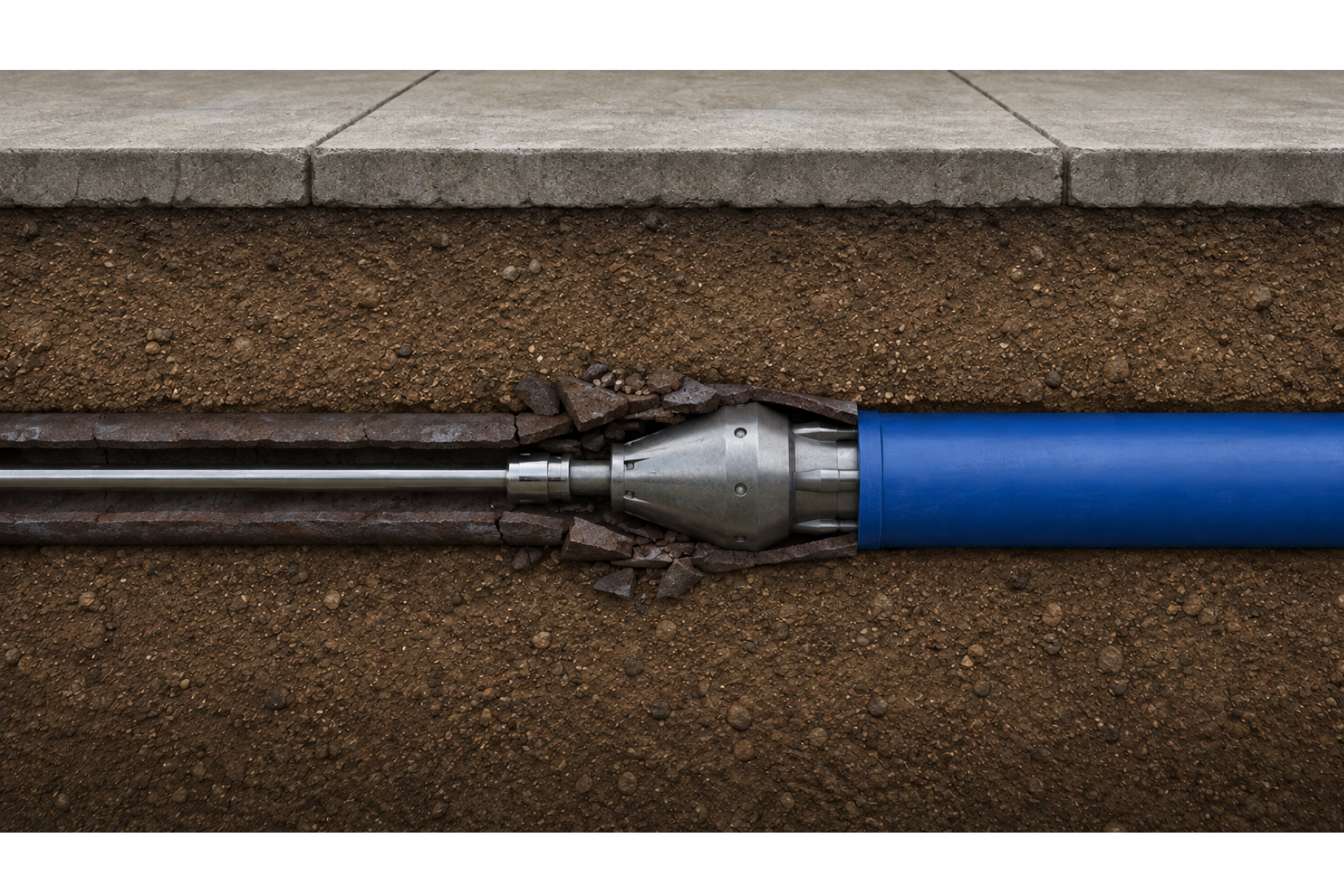
Pipe bursting is a trenchless method for replacing an existing underground pipe by breaking, splitting or displacing the old pipe while simultaneously installing a new pipe in its place. The existing pipeline acts as the pathway for the replacement. A contractor generally establishes access at each end of the section being replaced. A bursting or splitting head is connected to rods, cable or another pulling system. As the head moves through the existing line, it creates enough space for the new replacement pipe being pulled behind it. The result is a completely new underground pipe without excavating the entire length of the old one.
Is Pipe Bursting the Same as Pipe Lining?
No.
This is one of the most important differences for property owners to understand. Pipe lining rehabilitates an existing pipe. With cured-in-place pipe, or CIPP, a liner is installed inside the existing pipe and cured to form a new structural line within it. Pipe bursting replaces the existing pipe. The old pipe is broken, split or moved outward and a completely new replacement pipe is installed along its path. Neither method is automatically better. The right choice depends on what is actually wrong with the pipe.
How Does Pipe Bursting Work?
Although equipment and procedures vary, most pipe-bursting projects follow a similar process. 1. The Existing Pipe Is Inspected The contractor first needs to determine:
- What the pipe is made from
- Its diameter
- Its depth
- Its route
- Its approximate length
- Where connections are located
- What has failed
- Whether the existing alignment can be used
For sewer work, this usually includes a camera inspection. For water lines, additional locating and utility information may be required. The repair method should be chosen after the pipe has been evaluated, not before.
2. Underground Utilities Are Located Pipe bursting physically displaces the existing pipe and some surrounding soil. That makes the location of nearby utilities extremely important. The contractor must consider water, sewer, natural gas, electric, telecommunications and other buried infrastructure before beginning.
3. Access Points Are Created Pipe bursting is trenchless, but trenchless does not necessarily mean zero digging. Most projects require an insertion point and a receiving or pulling point. Additional excavation may be needed for connections.
The difference is that contractors generally avoid excavating one long trench over the entire pipeline. That could save your driveway, landscaping, or even portions of your home or building.
4. The Pulling System Is Installed Depending on the equipment, contractors may use:
- Pulling cable
- Steel rods
- Hydraulic systems
- Pneumatic systems
- Static bursting equipment
The system is established through the existing pipe.
5. The Old Pipe Is Broken, Split or Cut This is where the existing pipe material becomes extremely important. A brittle clay pipe behaves differently from PVC. Cast iron behaves differently from ductile iron. Different materials may require completely different heads or cutting tools.
6. The New Pipe Is Installed The replacement pipe is attached behind the bursting equipment and pulled into position as the old pipe is displaced. The new pipe generally follows approximately the same underground route as the original.
7. Connections Are Made and the Installation Is Verified
The contractor reconnects the required services and completes appropriate testing or inspection. For sewer replacement, ask for a post-installation camera inspection. For potable-water replacement, pressure testing, disinfection, inspection and other requirements may apply depending on the jurisdiction and project.
Is Pipe Bursting Really Trenchless?
Yes.
But a better description is minimal-excavation pipe replacement rather than “no digging whatsoever.” Most pipe-bursting projects require some access excavation. The advantage is that it avoids digging a continuous trench that conventional pipe replacement often requires. That can dramatically reduce damage to:
- Lawns
- Landscaping
- Driveways
- Sidewalks
- Parking areas
- Patios
- Other finished surfaces
What Types of Pipes Can Be Replaced
With Pipe Bursting?
Pipe bursting can be used on many different underground pipe materials, but the equipment must be appropriate for the existing material. Clay Pipe
Vitrified clay sewer pipe is commonly associated with pipe bursting. Clay is brittle and can generally be fractured and displaced as the replacement pipe is pulled into position.
Cast Iron Many cast-iron sewer and water lines can be replaced using pipe bursting. Cast iron is relatively brittle compared with materials such as ductile iron and can often be fractured using properly configured bursting equipment.
Orangeburg Pipe Deteriorated Orangeburg sewer lines may be candidates for pipe bursting. Orangeburg can deform and deteriorate significantly with age, making complete replacement preferable to rehabilitation in some situations. The contractor should determine whether the original pipe alignment can still be followed.
PVC PVC can sometimes be replaced using pipe bursting, but it does not shatter in the same manner as brittle clay. Special cutting or splitting blades may be required. Not every pipe-bursting machine or head is designed for PVC replacement.
Ductile Iron Ductile iron typically requires specialized pipe splitting or cutting technology rather than simply attempting to fracture the pipe. The old line may be split longitudinally to create room for the replacement pipe.
Again, contractor equipment matters.
Water Service Lines Specialized small-diameter trenchless equipment can be used for certain water service replacement projects. These systems are substantially different from simply attaching a standard sewer bursting head to a lead service. Municipal requirements and lead-service replacement rules also need to be followed.
What Problems Can Pipe Bursting Solve?
Pipe bursting may be considered when an underground pipe has:
- Severe corrosion
- Repeated failures
- Structural deterioration
- Major cracking
- Root intrusion
- Aging joints
- Multiple failed sections
- Orangeburg deterioration
- Failing clay pipe
- Deteriorated cast iron
- Leaking water-service pipe
- An undersized existing pipeline
- Damage significant enough that replacement makes more sense than rehabilitation
The important question is not: “Can somebody pipe burst this?” The better question is: “Is complete replacement the right solution for this particular pipe?”
Can Pipe Bursting Replace a Collapsed Sewer Line?
Sometimes.
A collapsed sewer line does not automatically eliminate pipe bursting as an option. The contractor needs to determine whether the existing underground route can still be followed. If the pipe has completely lost its alignment, shifted significantly, developed severe grade problems or become inaccessible, excavation may be required. That is why a camera inspection is so important. “Collapsed sewer” describes a problem. It does not automatically determine the repair method.
Can Pipe Bursting Replace Orangeburg Sewer Pipe?
Often, yes.
Orangeburg was installed in many older American sewer systems and can deteriorate, flatten or collapse over time. Because pipe bursting installs a new replacement pipe rather than depending on the old Orangeburg pipe for long-term structural support, it may be a strong option when the line is suitable. Ask your contractor:
- How much of the line is Orangeburg?
- Has the pipe maintained its alignment?
- Is it badly deformed?
- Would lining still be practical?
- Would complete replacement provide the better result?
Can Pipe Bursting Replace Clay Sewer Pipe?
Yes.
Clay sewer pipe is one of the most common applications for pipe bursting. Because clay is brittle, properly selected bursting equipment can fracture it while pulling new pipe into approximately the same location.
Can Pipe Bursting Replace Cast-Iron Sewer Pipe?
Many cast-iron lines can be replaced using pipe bursting. However, cast iron is also a common candidate for CIPP lining when enough of the original pipe remains suitable for rehabilitation. For cast iron, property owners should ask contractors to compare: Repairing the existing line with CIPP versus Completely replacing it through pipe bursting.
Can Pipe Bursting Install a Larger Pipe?
Potentially, yes. One important advantage of pipe bursting is the ability in certain conditions to install a replacement pipe that is larger than the existing one. This is called upsizing. It can be useful when:
- A sewer line is undersized
- A property needs additional capacity
- A water line needs increased flow
- A municipality is upgrading an aging water main
However, upsizing means more soil displacement. The contractor must evaluate nearby utilities, soil, structures, pipe depth and the amount of expansion required. It is not unlimited.
Can Pipe Bursting Be Used for Water
Lines?
Yes. Pipe bursting is not limited to sewer pipes. Properly designed pipe-bursting systems are used to replace water mains and certain smaller water service lines. Waterline replacement can be especially attractive when the old pipe runs beneath:
- A driveway
- Sidewalk
- Parking lot
- Mature landscaping
- Patio
- Established lawn
- Other expensive surface improvements
Instead of excavating the entire route, a contractor may be able to replace the old waterline through limited access areas.
Can Pipe Bursting Replace the Water Line From the Street to My House?
Potentially.
Certain specialized pipe-bursting and pipe-slitting systems are designed for smaller lateral and water-service applications. These can sometimes replace the underground water service connecting a house or building to the public water system. But this is where equipment capability becomes extremely important. A contractor needs to evaluate:
- Existing waterline diameter
- Existing material
- Replacement material
- Length
- Depth
- Pulling force required
- Connections
- Nearby utilities
- Soil
- Local plumbing codes
- Water-utility requirements
Do not assume that a contractor who owns sewer pipe-bursting equipment can automatically replace your water service. Ask directly: “Is your specific equipment and tooling designed for this waterline size and material?”
How Does Pipe Bursting Work for Waterline Replacement?
The basic principle is similar to sewer replacement. The existing waterline becomes the pathway for the new pipe. A contractor determines the old pipe's:
- Route
- Size
- Material
- Depth
- Connection points
- Nearby utilities
A pulling system is then established through the existing line. The appropriate bursting, cutting or splitting head travels through the old pipe while the new pressure-rated water pipe is pulled behind it. The old pipe is opened or displaced and the new waterline takes its place. Because drinking-water systems are involved, potable-water installations must comply with applicable:
- Plumbing codes
- Utility requirements
- Approved material standards
- Pressure-testing procedures
- Sanitation requirements
- Inspection requirements
What Type of New Pipe Is Used for Waterline Pipe Bursting?
HDPE, or high-density polyethylene, is commonly used for pipe-bursting replacement because it can be heat-fused into long continuous sections and pulled underground. However, it is not the only possible material. Depending on the project, approved pressure pipe such as fusible PVC or other engineered systems may be used. Property owners should ask: What exact pipe are you installing? Is it approved for potable water? What pressure rating does it have? How are the joints connected?
What warranty does the manufacturer provide?
What warranty does the contractor provide?
“New plastic pipe” is not a detailed enough answer.
Can Pipe Bursting Replace a Water Line
Under a Driveway?
Potentially, yes. This can be one of the most attractive applications for trenchless waterline replacement. With conventional excavation, replacing a waterline underneath a driveway could also mean: 1. Cutting the driveway. 2. Excavating the waterline. 3. Installing the new pipe. 4. Backfilling the trench. 5. Repairing or replacing the concrete or asphalt. When conditions allow, trenchless replacement may dramatically reduce that surface destruction. There will generally still be access points excavation, but comparatively far less than conventional replacement.
Can Pipe Bursting Increase the Size of a Water Line?
Potentially.
Pipe bursting can sometimes replace an existing waterline with a larger one. This can help when an existing water pipe is undersized or when increased capacity is needed. However, installing a larger pipe requires more displacement of the surrounding ground.
Nearby utilities and structures become increasingly important as the size increase grows. Upsizing should be engineered and planned—not assumed.
Why Can't Every Pipe-Bursting Machine Replace Water Lines?
Because pipe bursting is an entire category of equipment, not one universal machine. Systems vary in:
- Pulling force
- Rod size
- Cable size
- Pipe-diameter capacity
- Bursting-head design
- Cutting blades
- Pipe splitters
- Replacement-pipe capacity
- Machine dimensions
- Access requirements
One system may be excellent for replacing a 4-inch clay sewer lateral. Another may be built for a small water service. Another may be designed for large municipal water mains. Another may have specialized tooling for ductile iron, steel, PVC or lead. That is why the most useful question for a property owner is not: “Do you own a pipe burster?” It is: “Do you have the correct system, tooling and experience for my exact pipe?”
How Much Does Pipe Bursting Cost?
There is no trustworthy one-price-fits-all answer. Published U.S. estimates vary widely, and residential pipe-bursting projects can cost substantially more or less depending on the property. The cost is influenced by much more than pipe length.
Factors That Affect Pipe Bursting Cost
Length Longer pipe replacements generally require more material and labor. Depth Deep sewer or water lines can require larger and more difficult access pits. Existing Pipe Material Clay, cast iron, PVC and ductile iron may require different tools and procedures. Diameter Larger pipe generally means larger equipment and more material. Access Working in a lawn can be very different from working next to a building, beneath concrete or in a confined area. Nearby Utilities Gas, electrical, water, sewer and telecommunications lines can affect the feasibility and difficulty of the project. Connections Branch connections and service connections require additional work. Soil Conditions
Pipe bursting displaces surrounding material, making soil conditions important. Permits and Inspections Local requirements vary widely. Surface Restoration Access pits may still require landscaping, concrete or pavement repairs.
Is Pipe Bursting Cheaper Than Traditional Excavation?
Sometimes.
The largest financial benefit often appears as cost savings from what open excavation would require destroying expensive surface improvements. Consider a sewer or water line running underneath:
- A concrete driveway
- Parking lot
- Mature landscaping
- Sidewalk
- Patio
- Retaining structures
With conventional replacement, you are not just paying to replace the pipe. You may also be paying to destroy and reconstruct everything above it. That means the real comparison should be: Total trenchless project cost versus Excavation + pipe installation + surface removal + reconstruction + landscaping + disruption. On a simple pipe running through an open dirt area, excavation may remain competitive.
On a difficult property, trenchless replacement can change the economics significantly.
How Long Does Pipe Bursting Take?
Many straightforward residential installations can be completed relatively quickly, sometimes within one or two days of active installation. But actual project schedules depend on:
- Utility locating
- Permits
- Inspection scheduling
- Length
- Depth
- Access
- Number of connections
- Pipe material
- Site conditions
- Restoration
Ask the contractor to distinguish between: Installation time and Total project timeline. They are not always the same.
Will Pipe Bursting Destroy My Yard?
Generally far less than conventional excavation. Some digging is still normally required, but pipe bursting eliminates the need for a continuous open trench in many projects. Before signing a contract, ask the contractor to physically identify:
- Every planned excavation area
- Approximate size
- What surfaces will be disturbed
- Who will restore them
- Whether restoration is included in the price
Pipe Bursting vs. Pipe Lining
Both are trenchless technologies, but they accomplish different things.
| Feature | Pipe Bursting | Pipe Lining / CIPP |
|---|---|---|
| Existing pipe | Broken, split or displaced | Remains in place |
| Result | Completely new replacement pipe | New structural liner inside old pipe |
| Full replacement | Yes | No |
| Excavation | Limited access generally required | Usually very limited |
| Can increase pipe size | Sometimes | No |
| Works with severely deteriorated pipe | Often | Depends on condition |
| Common sewer application | Yes | Yes |
| Waterline applications | Yes, with suitable systems | Not usually, but special conditions may apply |
| Inspection required | Yes | Yes |
When might pipe lining make more sense?
If an existing sewer can be properly prepared and structurally rehabilitated, CIPP may preserve the pipe with very little excavation.
When might pipe bursting make more sense?
If the existing pipe requires complete replacement, is too deteriorated for rehabilitation, or needs to be upsized, pipe bursting may be more appropriate.
A contractor who offers multiple technologies should be able to explain why one is better for your specific pipe.
Pipe Bursting vs. Traditional Excavation
Conventional excavation is still sometimes the correct answer. Open excavation may be necessary when:
- The route must change
- The grade is incorrect
- The existing pipe has significantly shifted
- There is no usable existing pathway
- Utilities make bursting unsafe
- Physical repair of the surrounding area is required
The objective should not be to avoid excavation at all costs. It should be to use the least destructive method that gives the property owner a reliable long-term result.
When Is Pipe Bursting a Good Choice?
Pipe bursting may be worth considering when:
- The existing pipe needs complete replacement.
- Excavation would damage expensive surfaces.
- The existing pipe material can be burst or split.
- The current route can be reused.
- Nearby utilities allow safe installation.
- Pipe upsizing is desirable.
- An aging sewer has widespread failures.
- A water service is deteriorating or leaking.
- The contractor has the proper equipment and experience.
When Might Pipe Bursting NOT Be
Appropriate?
Potential limitations include:
- Major grade problems
- Significant changes in alignment
- Extremely close utilities
- Difficult access
- Unknown underground conditions
- Inappropriate pipe material for available equipment
- Insufficient pulling capacity
- Complete loss of the original pipe route
- Conditions requiring relocation rather than replacement
Pipe bursting is powerful technology. It is not the correct answer for every underground pipe.
Does Homeowners Insurance Cover Pipe Bursting?
Possibly. Insurance coverage generally depends more on why the pipe failed and what coverage you purchased than on whether the contractor uses pipe bursting. Standard homeowners policies often treat ordinary wear, deterioration and maintenance differently from sudden covered events. Some homeowners also purchase separate:
- Service-line coverage
- Underground utility coverage
- Sewer-backup coverage
These are not necessarily the same thing. Before beginning a major repair, contact your insurer and ask:
- Is the underground pipe itself covered?
- Do I have service-line coverage?
- Does the cause of failure matter?
- Is sewer backup covered separately?
- What documentation is required?
- Do you need the camera inspection?
- Do you need photographs or a contractor's written diagnosis before repairs begin?
Questions to Ask a Pipe-Bursting
Contractor Before hiring anyone, ask: 1. Can you show me exactly what failed? 2. Why are you recommending replacement instead of lining or repair? 3. What is my existing pipe made from? 4. What replacement pipe are you installing? 5. Is your pipe-bursting system specifically designed for this pipe material and size? 6. Where will you excavate? 7. Are nearby utilities a concern? 8. Will the new pipe follow the same grade and alignment? 9. Are permits and inspections included?
10. How long will my sewer or water service be unavailable?
11. How will you verify the final installation?
12. What restoration work is included?
13. What warranty applies to the pipe?
14. What warranty applies to the installation?
15. How many jobs like mine has your company completed?
For waterline projects, also ask: Is your equipment specifically configured for potable-water replacement? That matters.
Frequently Asked Questions About Pipe Bursting
Does pipe bursting completely replace the old pipe?
Yes. Pipe bursting is a replacement method. The existing pipe is broken, split, cut or displaced while a new pipe is installed in its place. Is pipe bursting only for sewer lines?
No. Pipe bursting can also be used for water mains and certain smaller water-service lines when appropriate equipment and procedures are used. Is pipe bursting the same as pipe lining?
No. Pipe lining rehabilitates the existing pipe. Pipe bursting replaces it. Does pipe bursting require digging? Usually some digging is required for access and connections, but the process generally avoids excavating one continuous trench over the entire pipe. Can pipe bursting replace Orangeburg? Often, yes, depending on the condition and alignment of the existing sewer. Can pipe bursting replace clay sewer pipe?
Yes. Clay pipe is a common pipe-bursting application. Can pipe bursting replace cast iron? Many cast-iron sewer and water pipes can be replaced using appropriate pipe-bursting equipment. Can pipe bursting replace PVC?
Potentially. PVC generally requires suitable cutting or splitting tooling rather than being treated like brittle clay. Can pipe bursting replace ductile iron? Yes, in certain applications, but specialized splitting or cutting technology is generally required. Can pipe bursting replace a lead water service? Specialized trenchless equipment can be used for certain lead service-line replacement projects, subject to local utility and regulatory requirements. Can pipe bursting replace the water line from the street to my house?
Potentially. Specialized systems are available for smaller water-service replacement. The contractor must evaluate the pipe material, diameter, route and local requirements. Can pipe bursting replace a water line under a driveway? Potentially, yes. Avoiding complete driveway excavation can be one of the biggest advantages of trenchless waterline replacement. Can pipe bursting fix tree-root problems? If root intrusion results from a failing sewer, replacing the old sewer with a new pipe can eliminate those failed joints and damaged sections. Can a collapsed sewer be pipe burst?
Sometimes. The contractor must still be able to establish a suitable path through or along the old pipe route. Can pipe bursting install a larger pipe?
Potentially. Certain projects can replace the original pipe with a larger diameter, although soil conditions, utilities and other factors limit how much upsizing is practical. Can pipe bursting install a completely new waterline?
Not if there is no existing pipe to follow. A completely new alignment generally requires directional drilling, piercing, boring or another new-installation method. Is sewer pipe-bursting equipment the same as waterline equipment? Not necessarily. Some machines can handle multiple applications with the correct accessories, while others have specific limitations. Different pipe sizes and materials may require entirely different heads, blades, splitters and pulling capacities. How much does pipe bursting cost? There is no reliable universal price. Cost depends on length, depth, access, pipe diameter, existing material, utilities, excavation requirements, connections, permits and restoration. Is pipe bursting cheaper than digging? It can be, especially when conventional excavation would also require expensive driveway, pavement or landscape reconstruction. How long does pipe bursting take? Many uncomplicated residential installations can be completed relatively quickly, but permitting, utility locating, inspections and site complexity affect the complete project timeline. How long does a pipe-bursting replacement last? Like conventional pipe replacement, service life depends on the life use of the replacement pipe, installation quality, operating conditions and manufacturer specifications. Ask for documentation on the exact material being installed rather than accepting a generic lifespan claim.
Pipe Bursting, Pipe Lining or Excavation: Start With the Problem
The biggest mistake a property owner can make is choosing the technology before understanding the pipe. Some underground pipes should be lined. Some should be burst and replaced. Some need localized repair. Some should be excavated. Some waterline projects require directional drilling or another trenchless technique rather than bursting. And some properties may benefit from more than one method. Modern trenchless technology gives property owners more options. The goal should not be to choose the method that sounds newest. The goal should be to determine: What failed? Why did it fail? What condition is the rest of the pipe in? Can it be rehabilitated? Does it need to be completely replaced? What method can accomplish that with the least unnecessary damage to the property? Those are the questions a qualified trenchless contractor should answer.
Find a Pipe Bursting or Trenchless Contractor Near You
If you are dealing with a damaged sewer line, leaking water service or another failing buried pipe, you may have more options than conventional excavaZtion.
Pipelining.com helps property owners locate trenchless pipe repair and replacement professionals serving their area. A qualified contractor can inspect the existing pipe, explain the available technologies and determine whether pipe lining, pipe bursting, trenchless waterline replacement or another solution is appropriate. The pipe may need to be replaced. Your entire property may not need to be torn apart to do it.