
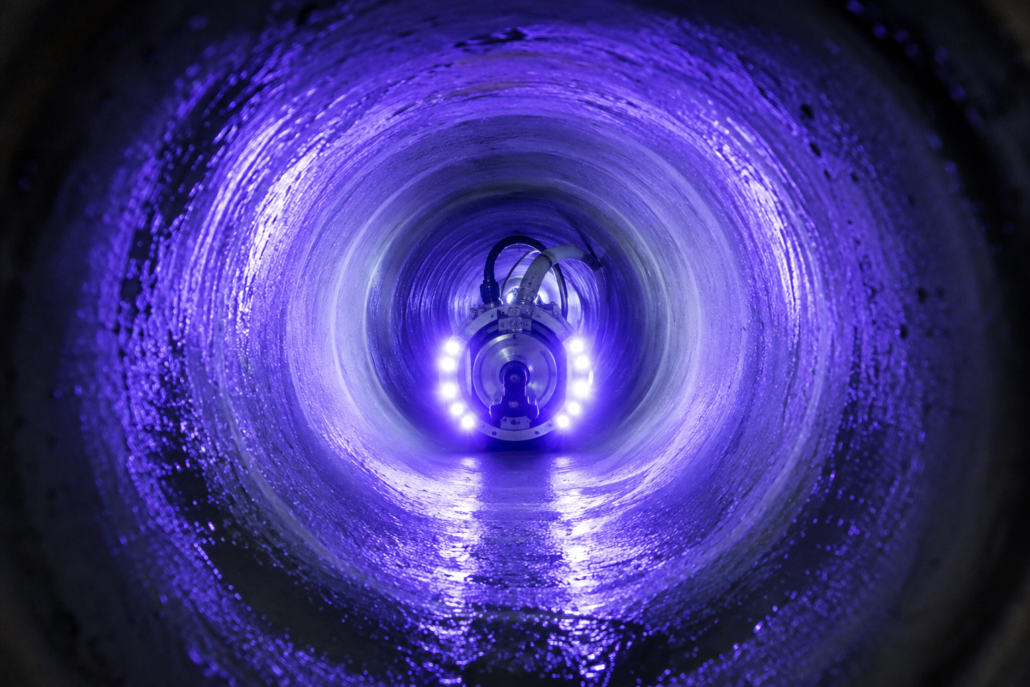
Today, many plumbing and trenchless pipe repair contractors use UV pipe lining, also known as UV CIPP, UV cured-in-place pipe lining or ultraviolet pipe relining, to rehabilitate damaged pipes from the inside.
If you have a cracked, leaking, corroded or deteriorating sewer pipe, replacing the entire pipe may not be your only option.
Instead of excavating an entire sewer line, breaking concrete floors or tearing through landscaping, a contractor may be able to install a new structural liner inside the existing pipe and cure it with controlled ultraviolet light.
For homeowners, businesses, property managers and building owners, that can mean considerably less disruption to the property and a much faster return to normal use.
But UV pipe lining is not right for every pipe. Here is what property owners should understand before choosing UV lining—or any other trenchless sewer repair method.
What Is UV Pipe Lining?
UV pipe lining is one method of cured-in-place pipe rehabilitation, commonly abbreviated CIPP. CIPP creates a new pipe inside an existing damaged pipe.
A flexible resin-impregnated liner is positioned inside the existing sewer or drain line. The liner is expanded against the interior walls of the old pipe. A specialized light source then travels through the liner and activates photoinitiators in the resin. As the resin cures, the flexible liner becomes a hardened pipe within the original pipe.
Light-cured CIPP technology has continued to evolve, and contractors may use fiberglass, felt, woven or hybrid liner technologies depending on the particular system and application. UV and LED light-curing equipment are also available for different pipe sizes and project conditions. (NASSCO)
Why Are Plumbing Contractors Using UV Pipe Lining?
The simple answer is control, speed, and reduced disruption.
Traditional pipe replacement usually requires contractors to physically reach the damaged pipe. When sewer pipes run beneath landscaping, driveways, parking lots, finished floors, foundations or commercial buildings, reaching them can create a substantial construction project.
Trenchless pipe lining changes the equation. Instead of focusing first on how to remove the old pipe, a trained pipe lining contractor evaluates whether the existing pipe can be rehabilitated internally. That can preserve much more of the property surrounding the pipe. UV curing gives contractors another tool for completing that rehabilitation efficiently.
UV Pipe Lining Can Reduce Property Damage
One of the biggest advantages of trenchless sewer repair has nothing to do with ultraviolet light. It is what contractors may not have to destroy.
Imagine a deteriorated cast iron sewer line running underneath a finished basement, restaurant kitchen, warehouse floor, hotel, condominium, driveway or carefully landscaped yard. Conventional replacement may require access to that pipe through excavation or demolition.
CIPP lining is installed inside the existing pipeline. NASSCO describes CIPP as a trenchless rehabilitation technology that creates a new seamless pipe inside the deteriorated host pipe and can be used to address defects including cracks, leaks and corrosion. (NASSCO)
There may still be access work, cleaning, excavation or other preparation required on certain jobs. “Trenchless” does not guarantee absolutely zero digging. But when a pipe is a suitable candidate for lining, the difference in disruption can be significant. For many property owners, avoiding unnecessary demolition is one of the most valuable benefits of pipe lining.
UV Curing Can Help Contractors Complete Repairs Faster
A sewer repair is not finished simply because a liner has been placed inside the pipe. The resin has to cure properly. Different CIPP systems accomplish this using different methods, including ambient cure, hot water, steam and light.
With UV pipe lining, curing begins when the properly matched resin system is exposed to the appropriate wavelength of light. NASSCO explains that light-cure resins use photoinitiators that respond to specific wavelengths, initiating the curing reaction. (NASSCO)
This gives trained contractors the ability to control when the cure process begins and move the curing source through the liner according to the manufacturer's specified procedure.
Depending on the pipe, liner, equipment and job conditions, that controlled curing process can contribute to shorter installation schedules. For a homeowner, business or facility, shorter pipe-rehabilitation projects can mean less downtime, fewer interruptions and quicker restoration of normal plumbing service.
Actual installation time varies considerably, however. Pipe diameter, length, access, cleaning requirements, liner design, branch connections and the existing condition of the sewer all matter. Be cautious of any contractor who promises an exact installation time without first inspecting your piping system.
Better Pipe Repair Starts With Better Inspection
UV technology does not eliminate the need for skilled plumbing work. In fact, one of the most important parts of a successful pipe lining project happens before the liner ever goes into the pipe.
The contractor should inspect the existing piping system with a sewer camera and determine what is actually wrong.
Pipe lining may be appropriate for corrosion, cracks, leaking joints, holes, root intrusion and other types of deterioration when enough of the original pipe remains to support the lining process. A completely collapsed pipe, severely offset section, significant belly or other major structural problem may require excavation, pipe bursting, replacement or another solution.
The best trenchless contractor is not simply the contractor who can line a pipe. It is the contractor who knows when a pipe should be lined—and when it should not.
Why Preparation Matters So Much
Think of pipe lining as installing a new interior structure. The condition of the surface underneath it matters.
Before installation, contractors may need to remove grease, scale, corrosion, roots, mineral buildup or other obstructions. Depending on the pipe, this can involve hydro jetting, mechanical cleaning, descaling or specialized robotic equipment.
Essential Steps Before Lining Begins:
- Comprehensive cleaning and descaling
- Secondary camera re-inspection
- Precise measurements
- Selection of matching liner, resin, and curing procedure
Only after that preparation should lining begin. A premium UV curing machine cannot compensate for improper cleaning, the wrong liner, poor measurements or inadequate installation practices. The equipment matters. The contractor matters more.
Does UV Pipe Lining Create a Structural Pipe?
It can. CIPP is not simply paint applied to the inside of a sewer.
Depending on the liner design and application, the finished liner can provide significant structural rehabilitation to the existing pipeline. NASSCO describes CIPP as creating a seamless structural pipe within the deteriorated host pipe and notes its use throughout sewer rehabilitation. (NASSCO)
However, homeowners should not assume every liner is identical. Liner material, resin chemistry, wall thickness, pipe diameter, loading conditions and structural design can differ substantially from one project to another.
Ask your contractor what product is being installed, what standards or specifications apply to it, what warranty is provided and whether the liner is designed as a structural rehabilitation for your specific application.
Is UV Pipe Lining Safer?
“Safer” needs some explanation.
For the property, trenchless pipe lining can reduce many of the risks associated with extensive demolition and excavation because contractors may not need to expose the entire pipeline. That can mean less cutting of concrete, less excavation around existing structures and utilities, less landscape disturbance and a smaller construction footprint.
For workers and occupants, however, all pipe rehabilitation methods require appropriate safety procedures. Resin chemistry varies. Ventilation, handling procedures, personal protective equipment and jobsite controls remain important. ASTM specifically notes that users of UV CIPP technology are responsible for establishing appropriate safety, health and environmental practices. (ASTM Store)
A reputable contractor should be able to explain both the product being installed and the safety procedures used during installation.
Is UV Pipe Lining Better Than Steam-Cured CIPP?
Not automatically. UV light curing, steam curing, hot-water curing, ambient curing and other pipe rehabilitation technologies all have appropriate applications.
NASSCO specifically advises that both steam and UV curing can be good CIPP technologies when installed correctly by qualified contractors. Site conditions, emissions considerations, sewer size, project length and other factors influence which method makes the most sense. (NASSCO)
That is important for property owners. You should not choose a contractor simply because the company owns a particular brand or type of curing equipment. Choose the contractor who properly diagnoses your pipe and can explain why the proposed repair method is appropriate for your property.
Can UV Pipe Lining Repair Cast Iron Sewer Pipes?
In many situations, yes. Aging cast iron is one of the reasons property owners investigate trenchless pipe repair in the first place.
Cast iron can develop internal corrosion, scaling, cracks, weak sections and deterioration over time. When the existing pipe retains enough structural shape and can be properly cleaned and prepared, CIPP may be considered as a rehabilitation option.
This can be particularly valuable when cast iron piping runs beneath a concrete slab or through areas where conventional replacement would require extensive demolition. The decision should always begin with a professional camera inspection and proper evaluation of the existing pipe.
Can UV Pipe Lining Repair Sewer Lines Under a House?
Potentially—and this is one of the situations where trenchless rehabilitation can provide enormous value.
Sewer pipes beneath slabs, finished basements and buildings can be expensive and disruptive to reach using conventional methods. If the existing pipe is suitable for CIPP rehabilitation and sufficient access is available, a pipe lining contractor may be able to restore the pipe internally without opening the entire floor above it.
The exact installation method will depend on the building, pipe configuration and access points.
How Long Does Pipe Lining Last?
There is no responsible way to give every pipe lining project the same lifespan. Materials, design, pipe condition, installation quality, wastewater characteristics and operating conditions all affect service life.
However, CIPP is not a new experimental technology. NASSCO notes that cured-in-place pipe has been used for pipeline rehabilitation for more than 50 years. (NASSCO)
For lateral CIPP, NASSCO states that a properly designed, installed and tested renewed lateral can have a minimum life expectancy of 50 years. (NASSCO)
Property owners should still ask about the specific liner being proposed rather than relying on a generic industry claim. Ask for the manufacturer's specifications, warranty information and expected service life for the actual product being installed in your pipe.
How Do I Know Whether My Sewer Pipe Can Be Lined?
Start with evidence. A qualified sewer repair or trenchless contractor should inspect the pipeline using a camera before recommending rehabilitation.
The goal is not to purchase “UV.” The goal is to restore a failing pipe using the best technology for that particular pipe.
Finding a UV Pipe Lining Contractor Near You
If you are searching for UV pipe lining near me, sewer pipe lining near me, trenchless sewer repair, no-dig sewer repair, CIPP contractors, cast iron pipe lining or sewer line repair, look for a contractor with genuine pipe rehabilitation experience.
Pipe lining is a specialty. Experience with conventional plumbing does not automatically mean a company has extensive CIPP experience.
Ask potential contractors how often they perform pipe lining, what types and diameters of pipe they rehabilitate, how technicians are trained, how installations are documented and what happens if unexpected conditions are discovered. Then compare the proposed solution—not simply the price.